







 Italy / English
A
Agrafe
Small metal clip used to secure the cork during secondary fermentation and aging on the lees. It ensures resistance to internal pressure.
Amphore
Terracotta vessel used for the vinification and maturation of base wines. It promotes natural micro-oxygenation and thermal stability, preserving expressive purity while contributing to greater complexity and structure.
Appellation
French regulatory system that defines the geographical origin and production rules of a wine, ensuring its link to the territory. It establishes authorized grape varieties, yields, winemaking practices, and quality standards to be respected.
Arbane
White grape variety authorized in Champagne, belonging to the Cépages Oubliés. Very rare, it contributes high acidity and a fresh, delicate profile, adding finesse and tension to blends.
Argiles
Term referring to clay soils found in various areas of Champagne. They are distinguished by a higher water retention capacity and produce wines that are more structured and broad, with good depth and roundness.
Assemblage
Blending technique that combines different base wines by grape variety, origin, or vintage, with the aim of achieving balance, complexity, and stylistic consistency. It is a key stage in defining the identity of Champagne.
Autolyse
Natural process of yeast breakdown after fermentation, during aging on the lees. It releases compounds that enrich the wine in complexity, structure, and creaminess, contributing to the development of evolved aromas.
Autre Cru
Indication identifying villages not classified as Grand Cru or Premier Cru in the historical Échelle des Crus scale, totaling 258. It includes the majority of Champagne’s territories, with a wide variability of soils and production styles.
B
Balthazar
Large-format Champagne bottle with a capacity of 12 liters, equivalent to 16 standard bottles. It promotes slower and more harmonious aging, contributing to greater complexity, finesse, and stability over time.
Bar sur Aubois
Current definition referring to the Côte des Bar area linked to the Aube river, around Bar-sur-Aube. It represents a more precise geographical reference, now used to describe this part of the Champagne vineyard.
Barséquanais
Historical term referring to the Côte des Bar area developed around the Seine river, centered on Bar-sur-Seine. It identifies a part of the Champagne vineyard that is less commonly used in classification today.
Bâtonnage
Practice of stirring the fine lees in base wines during maturation. It promotes contact between wine and yeasts, contributing to greater complexity, volume, and integration, with effects on the wine’s structure and stability.
Blanc de Blancs
Term indicating a Champagne made exclusively from white grape varieties, mainly Chardonnay. It is distinguished by freshness, acidity, and finesse, with an elegant profile often marked by a pronounced mineral character.
Blanc de Meunier
Term indicating a Champagne made exclusively from Meunier grapes. It is distinguished by a fruit-driven and immediate profile, with good softness and approachability, while maintaining balance between freshness and roundness.
Blanc de Noirs
Term indicating a Champagne made exclusively from black grape varieties, such as Pinot Noir and Meunier. It is characterized by greater structure and intensity, with a broader and more vinous profile compared to other styles.
Blanc Vrai
White grape variety authorized in Champagne, traditional name for Pinot Blanc, belonging to the **Cépages Oubliés**. Rare, it contributes softness and roundness, adding balance and finesse to blends.
Bouchon couronne
Closure system using a crown cap during secondary fermentation and aging on the lees. It ensures an airtight seal and stability, allowing the controlled development of the second fermentation.
Bouteille
Standard Champagne bottle format with a capacity of 75 cl. It represents the reference unit for production and commercialization, ensuring balanced evolution between freshness, structure, and aromatic development over time.
Brut
Dosage indication that identifies a Champagne with residual sugar between 0 and 12 g/l. It is the most widespread style, characterized by a balance between freshness and roundness, with good versatility and accessibility.
Brut Nature
Dosage indication that identifies a Champagne with no added sugar, with residual sugar below 3 g/l, also referred to as Dosage Zéro, Pas Dosé, or Non Dosé. It is distinguished by a dry and direct profile, with a strong expression of the base wine.
Body
Sensation of structure and consistency of the wine on the palate, linked to elements such as alcohol, extract, and substance. It can range from light to full-bodied, contributing to the overall perception of balance and presence.
Balance
Sensation of harmony among the different components of the wine, such as acidity, alcohol, structure, and dosage. It indicates a proper balance of elements, with no single aspect prevailing, contributing to an overall coherent and pleasant perception.
Breadth
Sensation describing a wine that is broader and more expansive on the palate, with a less tense development and greater lateral spread. It indicates a smooth and enveloping progression, often linked to greater structure and roundness.
Biodynamic viticulture
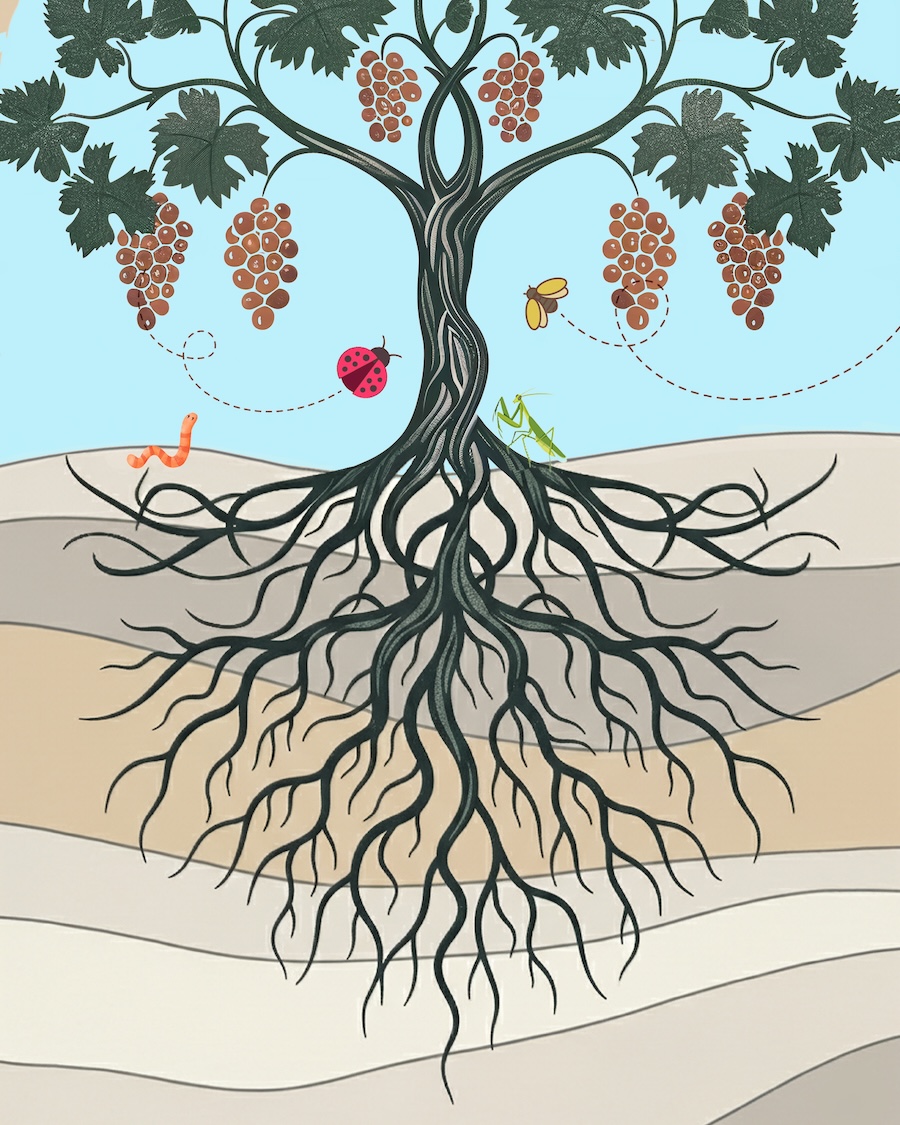
Farming method based on biodynamics, an agricultural system that considers the vineyard as a living organism. It involves natural practices and promotes soil balance and the expression of terroir.
C
Calcaire
Term referring to limestone soils widespread in Champagne, particularly in the form of chalk. They are distinguished by high drainage capacity and the ability to reflect heat, contributing to wines that are taut, fresh, and marked by a pronounced mineral character.
Cépages Oubliés
Term referring to historical grape varieties now rarely cultivated in Champagne, such as Arbane, Petit Meslier, Pinot Blanc (Blanc Vrai), and Pinot Gris (Fromenteau). Also known as forgotten grapes, they represent about 0.3–0.5% of the vineyard and contribute to diversity and complexity.
Châlons-en-Champagne
City in Champagne located in the Marne department, considered the administrative capital of the region. It is not a major wine-producing center but plays an institutional and logistical role within the Champagne area.
Champagne
Designation that identifies sparkling wines produced in the Champagne region according to strict rules set by the appellation regulations. It includes authorized grape varieties, production methods, defined areas, and minimum aging requirements on the lees.
Chardonnay
Main white grape variety of Champagne, widely planted on chalky soils. It is distinguished by freshness, elegance, and tension, contributing to finesse, longevity, and aromatic precision in Champagne wines.
Chef de Cave
Figure responsible for the technical management of production within a Maison or Domaine. Oversees blending, vinification, and the style of the wines, ensuring consistent quality and the expressive identity of Champagne over time.
CIVC
Acronym for Comité Interprofessionnel du Vin de Champagne, the body that brings together growers and producers. It regulates, protects, and promotes the appellation, ensuring compliance with production rules.
Clones du vignoble
Selection of vines that are genetically identical, obtained through vegetative propagation from a mother plant. Used to ensure productive and sanitary uniformity, it may reduce genetic variability compared to massal selection.
Clos
Term referring to a delimited and enclosed vineyard, often surrounded by walls, with a historical identity and specific characteristics. In Champagne, it identifies well-defined parcels valued for expressing their terroir in a distinctive way.
Club Trésor
Association of independent Champagne growers founded in 1971. It promotes terroir-driven Champagnes and brings together producers who share high quality standards, including the selected Special Club cuvées.
Coffret
Confezione a cofanetto utilizzato per presentare e proteggere la bottiglia di Champagne. Può essere realizzato in cartone, legno o altri materiali e contribuisce alla valorizzazione del prodotto, soprattutto per edizioni speciali o regalo.
Coiffe
Capsule that covers the upper part of the cork on Champagne bottles. It has a protective and aesthetic function, contributing to the product’s visual identity without affecting the wine’s preservation.
Coopérative
Associative structure, indicated by the abbreviation CM (Coopérative de Manipulation), which brings together multiple grape growers. It handles collective vinification and marketing, producing Champagne under a shared brand.
Cordon de Royat
Pruning system based on a permanent horizontal cordon with short spurs. It allows control of vigor and yield, promoting even grape ripening, and is authorized in Champagne mainly for Pinot Noir.
Côte des Bar
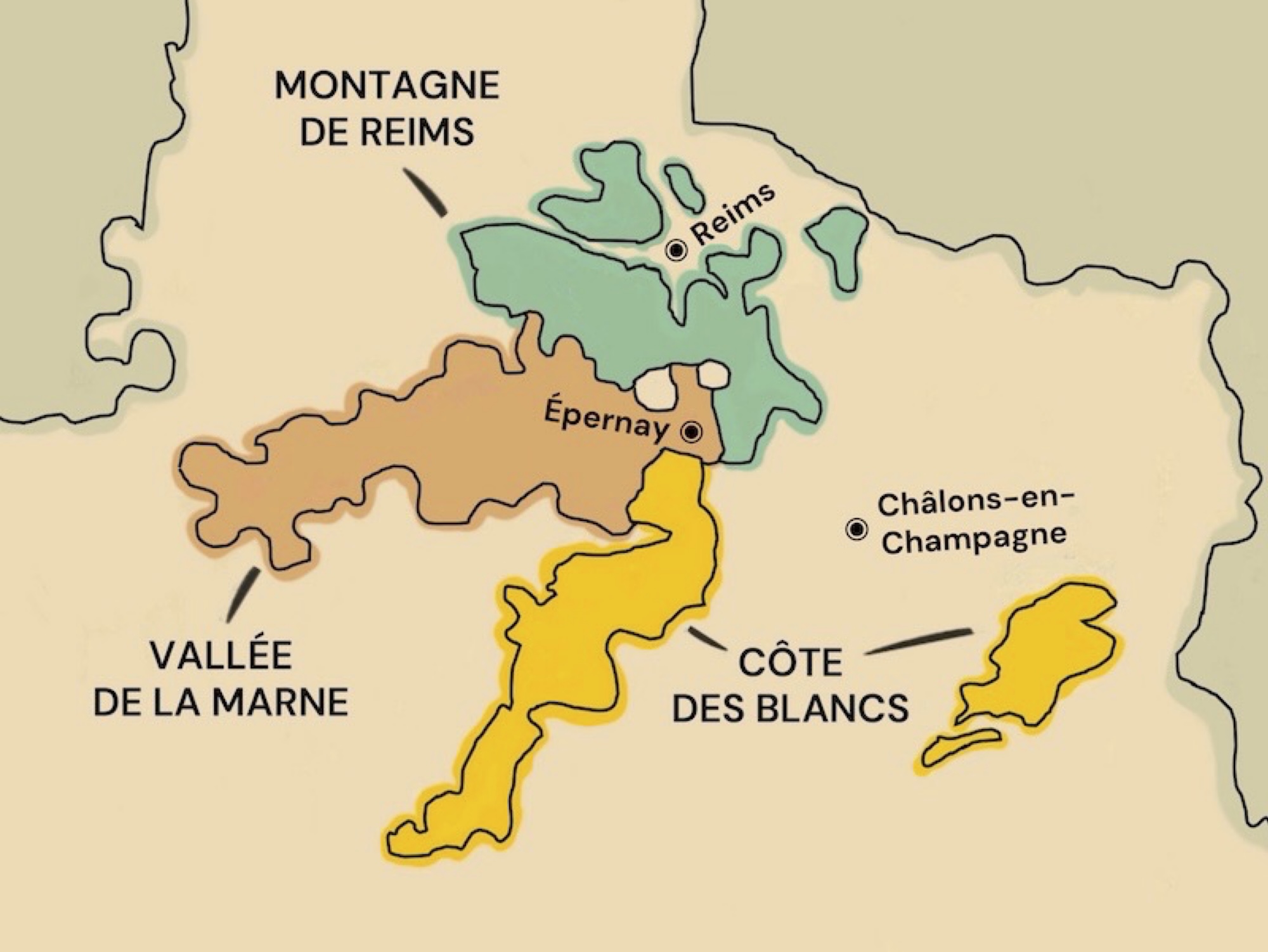
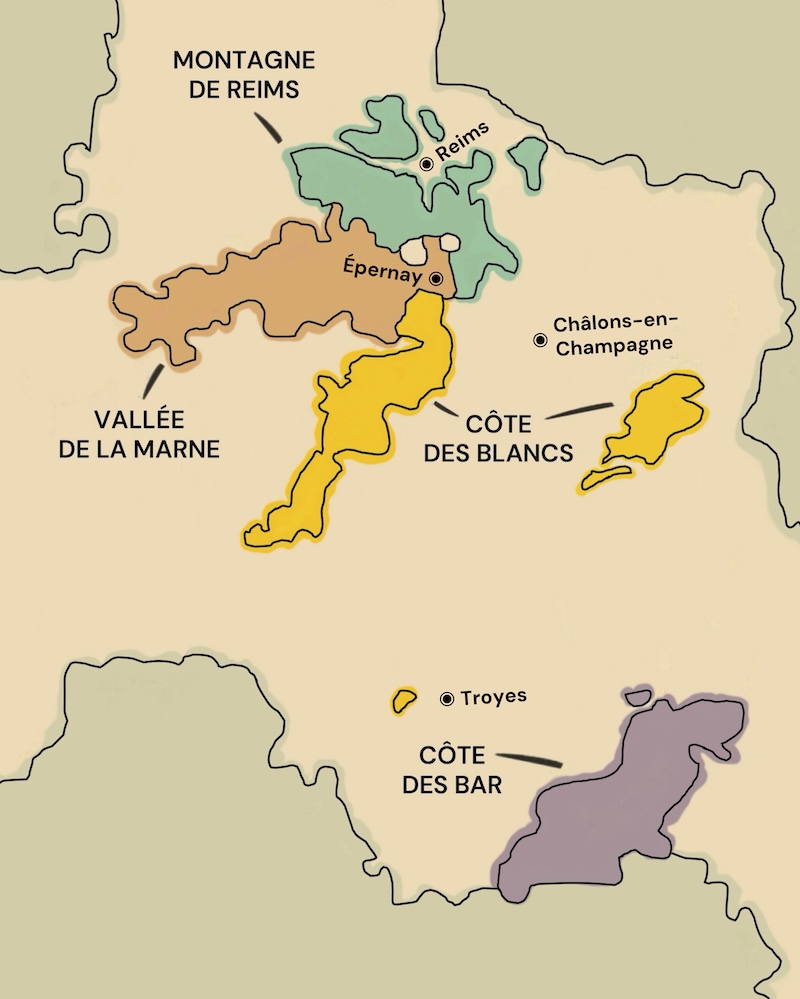
Southern Champagne area located in the Aube department, characterized by Kimmeridgian soils similar to those of Chablis. It stands out for the strong presence of Pinot Noir and for wines with a broader, more structured, and generous profile.
Côte des Blancs
Champagne area located south of Épernay, characterized by chalky soils that enhance the expression of Chardonnay. It is known for elegant, taut, and mineral wines, with pronounced freshness and citrus notes.
Coteaux Champenois
Designation that identifies still wines produced in the Champagne region, whether white, red, or rosé. Made from the same authorized grape varieties as Champagne, they stand out for structure and expressive purity, without undergoing secondary fermentation.
Coteaux du Petit Morin
Champagne area located southwest of the Côte des Blancs, characterized by mixed soils with marl and clay components. It stands out for a greater presence of Meunier and for wines with a softer, fruit-driven profile.
Coteaux du Sézannais
Champagne area located south of the Côte des Blancs, with chalky and marl-limestone soils. It is known for Chardonnay cultivation and for wines that are fresh, balanced, and slightly softer in style.
Coteaux sud d'Epernay
Champagne area located south of Épernay, in the Vallée de la Marne, characterized by sunny exposures and mixed soils with clay and limestone components. It stands out for the presence of Meunier and for wines with a softer, fruit-driven profile.
Craie
Term referring to chalk, a limestone rock typical of Champagne. It is distinguished by high porosity and its ability to retain water, ensuring both drainage and water reserve, contributing to wines that are fresh, taut, and of great finesse.
Crayères
Underground cellars carved into chalk, typical of Champagne, used for ageing bottles. They ensure ideal conditions of constant temperature and humidity, promoting slow maturation and harmonious development of the wine.
Creaminess
Soft and enveloping tactile sensation on the palate, often linked to the finesse of the perlage and ageing on the lees. It contributes to a velvety and balanced perception, enhancing the wine’s harmony and overall appeal.
Cru
Term referring to a vineyard or a group of parcels with specific characteristics of soil, exposure, and microclimate. In Champagne, it is also used to classify villages according to the historical Échelle des Crus system.
Cuve béton
Concrete vessel used for the vinification and fermentation of base wines. It ensures good thermal inertia and controlled micro-oxygenation, promoting balance and roundness without influencing the wine’s aromatic profile.
Cuve Inox
Stainless steel vessel used for the vinification and fermentation of base wines. It allows precise temperature control and preserves freshness, aromatic purity, and expressive precision, without oxidative or aromatic influence.
Cuvée
Term referring to the base wine or selection of wines intended for blending. It can also refer to the first fraction of juice from pressing, considered the highest quality for purity and balance.
Cuvée de Prestige
Term referring to a high-end cuvée obtained from the selection of the finest grapes and the most meticulous winemaking. It usually represents the producer’s top quality expression, with greater complexity, finesse, and ageing potential.
Conventional viticulture
Farming method based on traditional agricultural practices that may involve the use of synthetic chemical products for vine protection and nutrition. It aims to ensure yield and grape health through a technical and controlled approach.
Cœur de Cuvée
Term indicating the highest-quality portion of the cuvée, obtained from the first fractions of pressing. It is distinguished by greater purity, balance, and finesse, contributing to the overall quality of Champagne.
D
Débourbage
Operation of static clarification of the must after pressing, aimed at removing suspended solid particles. It allows for obtaining a clear must, promoting more regular fermentations and greater aromatic precision.
Dégorgement
Operation consisting of the removal of sediments deposited in the neck of the bottle after aging on the lees. It generally takes place after riddling and precedes dosage, allowing for a clear and stable Champagne.
Dégorgement à la glace
Disgorgement technique that involves freezing the neck of the bottle to facilitate the expulsion of the sediment. It allows for a quick and precise operation, limiting wine loss and preserving balance and quality.
Dégorgement à la volée
Manual disgorgement technique performed without freezing the neck of the bottle. It requires great precision and speed, with sediment expelled under pressure, preserving greater integrity and sometimes enhanced expressiveness of the wine.
Dégorgement tardif
Indication referring to a disgorgement carried out after extended aging on the lees. It allows for greater wine evolution, developing complexity, depth, and integration, while maintaining freshness and balance.
Demeter
International certification attesting to the application of biodynamic principles. It requires specific agricultural practices, the use of natural preparations, and vineyard management as a living organism, with a focus on balance, biodiversity, and the expression of terroir.
Demi-bouteille
Champagne bottle format with a capacity of 37.5 cl, equivalent to half a standard bottle. It allows for faster evolution compared to larger formats, while maintaining freshness and accessibility in the short term.
Demi-Sec
Dosage indication that identifies a Champagne with residual sugar between 32 and 50 g/l. It is distinguished by a soft and semi-sweet profile, with a clearly perceptible sweetness balanced by freshness.
Domaine
Term referring to a producer who owns their own vineyards, generally family-run. In Champagne, it is often associated with independent growers who directly manage cultivation, vinification, and marketing.
Dosage
Operation consisting of the addition of the liqueur d’expédition after disgorgement, to define the final sugar level of the Champagne. It influences the taste balance, modulating freshness, roundness, and the wine’s style.
Dosage Zéro
Dosage indication that identifies a Champagne with no added sugar, with residual sugar below 3 g/l, equivalent to Brut Nature. It is distinguished by a dry and direct profile, with a strong expression of the base wine.
Doux
Dosage indication that identifies a Champagne with residual sugar above 50 g/l. It is distinguished by a sweet and enveloping profile, with marked softness balanced by freshness.
E
Èchelle des Cru
Historical system for classifying Champagne villages based on a percentage quality scale. It determined grape prices and distinguished between Grand Cru, Premier Cru, and Autre Cru, no longer in use today but still relevant as an indicative reference.
Effervescence
Sensation linked to the presence of carbon dioxide in the wine, perceived as bubbles. It contributes to freshness, liveliness, and dynamism on the palate, influencing the overall perception of structure and balance.
Élevage sur lies
Aging phase on the lees after secondary fermentation, during which the wine remains in contact with the fine lees. It promotes autolysis and contributes to greater complexity, structure, and the development of evolved aromas.
Épernay
City in Champagne located in the Marne department, among the main centers of the appellation. It is home to numerous Maisons and represents a leading commercial and production hub for Champagne.
Extra Brut
Dosage indication that identifies a Champagne with residual sugar between 0 and 6 g/l. It is distinguished by a dry and precise profile, with a balance between tension and slight roundness, while maintaining a clear expression of the base wine.
Extra Dry
Dosage indication that identifies a Champagne with residual sugar between 12 and 17 g/l. Despite its name, it shows a slightly rounder profile, with a balance between freshness and a softer perception.
F
Fermentation alcoolique
Process during which yeasts convert the sugars in the must into alcohol and carbon dioxide. It represents a fundamental stage in the production of base wines, influencing structure, aromas, and the overall profile of the wine.
Fermentation malolactique
Process during which malic acid is converted into lactic acid by lactic bacteria. It reduces acidity and increases roundness. It can be carried out or blocked by the producer to preserve freshness or promote greater softness and stability.
Filtration
Operation consisting of passing the wine through filtering materials to remove suspended particles and microorganisms. It contributes to clarity and stability, while preserving the wine’s balance and quality.
Foudre
Large wooden cask with high capacity used for the maturation of base wines. It allows slow micro-oxygenation without marked aromatic influence, promoting balance, complexity, and integration of the wine’s components.
Franc de pied
Term referring to ungrafted vines, grown on their own roots without American rootstock. Rare in Champagne, it allows the preservation of the plant’s original characteristics, contributing to a more authentic expression of the terroir.
Freshness
Taste sensation primarily linked to acidity, which gives the wine liveliness and drive. It contributes to balance and drinkability, enhancing aromatic perception and making the profile more dynamic and tense.
Fromenteau
Grey-skinned grape variety authorized in Champagne, traditional name for Pinot Gris, belonging to the **Cépages Oubliés**. Very rare, it contributes structure and complexity, with a broader profile and greater richness in blends.
Fût de chêne
Small oak barrel, also known as a barrique, used for the vinification and maturation of base wines. It promotes more pronounced micro-oxygenation and adds subtle aromatic notes, contributing to structure, complexity, and roundness.
G
Grand Cru
Indication identifying villages classified at the highest level in the historical Échelle des Crus scale, totaling 17. It refers to grapes sourced exclusively from these territories, recognized for their high quality and particular viticultural aptitude.
Grande Montagne Nord
Area of the Montagne de Reims located on the northern slope, characterized by chalky soils and a cooler climate. It stands out for the presence of Pinot Noir and for wines that are elegant, taut, and marked by pronounced freshness.
Grande Montagne Sud
Area of the Montagne de Reims located on the southern slope, characterized by sunnier exposures and chalky soils. It stands out for the presence of Pinot Noir and for wines that are riper, broader, and more structured, while maintaining balance and good freshness.
Grande Vallée de la Marne
Area of the Vallée de la Marne located between Aÿ and Dormans, characterized by south-facing slopes with limestone soils. It stands out for the strong presence of Pinot Noir and for wines that are structured, broad, and highly expressive.
Guyot
Pruning system based on one or two fruiting canes and a renewal spur. It allows control of yield and promotes balanced grape ripening, and is among the most widely used methods in Champagne.
Gyropalette
Mechanized system used for the riddling of bottles. It allows automatic rotation and tilting, directing the sediment toward the neck quickly and uniformly, reducing time compared to the manual method.
H
Habillage
Set of external elements of the bottle, such as label, back label, capsule, and packaging. It represents the product’s visual identity and contributes to the recognition and communication of Champagne.
HVE
Haute Valeur Environnementale (HVE) environmental certification attesting to sustainable agricultural practices. It assesses biodiversity, resource management, fertilization, and vine protection, promoting a balanced and low-impact approach.
I
Integrated viticulture
Farming method based on the controlled and targeted use of agronomic interventions. It involves applying treatments only when necessary, with the aim of limiting environmental impact while maintaining grape quality and health.
J
Jéroboam
Large-format Champagne bottle with a capacity of 3 liters, equivalent to 4 standard bottles. It promotes slower and more harmonious aging, contributing to greater complexity, balance, and aging potential.
L
La Côte des Blancs
Central part of the Côte des Blancs where Grand Cru villages are concentrated. Characterized by outcropping chalk soils, it is ideal for Chardonnay and produces wines of great finesse, tension, and longevity.
Lies fines
Deposits made up of spent yeasts and solid particles, known as fine lees, formed after fermentation. Contact with fine lees during aging contributes to greater complexity, structure, and stability of the wine.
Lieu-Dit
Term referring to a vineyard parcel or area identified by a traditional name, recognized for specific characteristics of soil, exposure, and microclimate. It allows precise identification of the origin of the grapes and the expression of the terroir.
Liqueur d’expédition
Mixture added after disgorgement, composed of wine and sugar, used to define the dosage level of Champagne. It contributes to the final style, influencing the balance between freshness and roundness.
Liqueur de tirage
Mixture of wine, sugar, and yeasts added to the base wine before bottling (tirage). It initiates the second fermentation in the bottle, responsible for the formation of carbon dioxide and the development of effervescence.
M
Maceration
Technique that involves contact between must and skins to extract color, aromas, and phenolic compounds. Used mainly for rosé wines, it contributes to structure, aromatic intensity, and definition of the wine’s profile.
Magnum
Champagne bottle format with a capacity of 1.5 liters, equivalent to 2 standard bottles. Considered ideal for aging, it promotes slower and more harmonious maturation, with greater complexity and balance.
Maison
Term referring to a Champagne producer, generally identified by the abbreviation NM (Négociant-Manipulant). They may purchase grapes or base wines, which are then vinified and marketed under their own brand.
Marnes
Term referring to marl soils, composed of a mixture of clay and limestone. They are distinguished by good water retention capacity and produce wines that are balanced, with structure, depth, and a good aromatic expression.
Massif de Saint-Thierry
Area of the Montagne de Reims located northwest of Reims, characterized by sandy and limestone soils. It stands out for the presence of Meunier and Chardonnay and for wines with a softer, more approachable, and fruit-driven profile.
Mathusalem
Large-format Champagne bottle with a capacity of 6 liters, equivalent to 8 standard bottles. It promotes slow and stable aging, contributing to greater complexity, balance, and aging potential.
Melchisédech
Very large-format Champagne bottle with a capacity of 30 liters, equivalent to 40 standard bottles, also known as Midas. Rarely used, it promotes very slow aging, contributing to great complexity and long-term stability.
Meunier
Black grape variety widely grown in Champagne, particularly in the Vallée de la Marne. It is distinguished by early ripening and a fruity profile, contributing roundness, accessibility, and balance in blends.
Midas
Very large-format Champagne bottle with a capacity of 30 liters, equivalent to 40 standard bottles, also known as Melchisédech. Rarely used, it promotes very slow aging, contributing to great complexity and long-term stability.
Millésime
Indication identifying a Champagne produced from a single declared vintage, selected for the quality of the grapes. It must age at least 36 months on the lees and primarily reflects the climatic and stylistic characteristics of the harvest.
Monopole
Term referring to a vineyard owned and vinified by a single producer. It represents a rare situation in Champagne and ensures full control over production, enhancing the identity and expression of the terroir.
Mont de Berru
Area of the Montagne de Reims located east of Reims, characterized by sandy and limestone soils. It stands out for the presence of Chardonnay and for wines with a more delicate, fresh profile and good finesse.
Montagne de Reims
Champagne area located between Reims and Épernay, characterized by forested hills and chalky soils. It stands out for the predominance of Pinot Noir and for wines that are structured, intense, and well-balanced, often with good aging potential.
Montgueux
Champagne village located in the south, near Troyes, considered a southern extension of the Côte des Blancs. Characterized by chalky soils, it is suited to Chardonnay and produces wines that are elegant, taut, and marked by good freshness.
Muselet
Wire cage used to secure the cork in Champagne bottles. It ensures resistance to internal pressure, keeping the cork stable and safe during storage and service.
N
Nabuchodonosor
Very large-format Champagne bottle with a capacity of 15 liters, equivalent to 20 standard bottles. It promotes very slow and harmonious aging, contributing to high complexity, balance, and aging potential.
Non Dosé
Dosage indication that identifies a Champagne with no added sugar, with residual sugar below 3 g/l, equivalent to Brut Nature. It is distinguished by a dry and direct profile, with a strong expression of the base wine.
O
Œil de Perdrix
Term referring to a very pale rosé Champagne, known as “partridge eye,” obtained from a short maceration of black grape varieties. It is distinguished by its delicate color and subtle profile, with good freshness and aromatic finesse.
Œnotheque
Term referring to a selection of bottles aged longer in the producer’s cellars, also known as Vinothèque. They represent evolved wines with greater complexity, depth, and aromatic development over time.
Œuf béton
Oval-shaped concrete vessel used for the vinification and maturation of base wines. It promotes natural convection currents and micro-oxygenation, contributing to balance, complexity, and greater integration of the wine.
Ouest
Area of the Vallée de la Marne located in the western part, characterized by more clay and sandy soils. It stands out for the predominance of Meunier and for wines with a softer, fruit-driven profile and immediate expression.
Organic viticulture
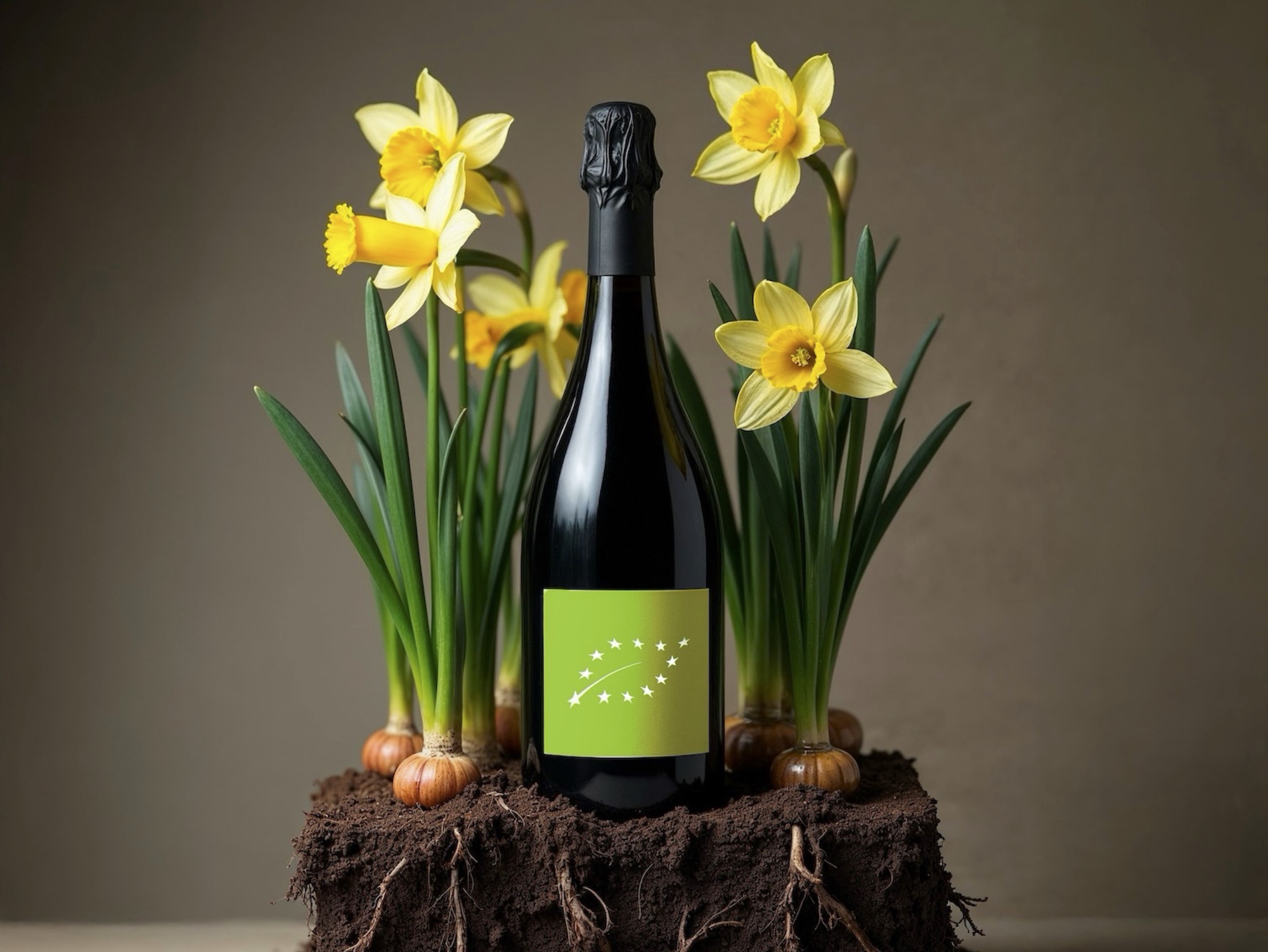
Farming method that excludes the use of synthetic chemical products, favoring natural substances and sustainable practices. It is recognizable only through official certification, which attests to its compliance with established standards.
P
Parcellaire
Term referring to a Champagne produced from a single parcel or a delimited area. It aims to express the characteristics of the terroir with precision, highlighting the identity, specificity, and uniqueness of the vineyard of origin.
Pas Dosé
Dosage indication that identifies a Champagne with no added sugar, with residual sugar below 3 g/l, equivalent to Brut Nature. It is distinguished by a dry and direct profile, with a strong expression of the base wine.
Perlage
Term referring to the set of bubbles present in the wine, assessed for finesse, intensity, and persistence. It represents a distinctive element of Champagne, contributing to tactile sensation, freshness, and perceived quality.
Perle Blanche
Area of the Montagne de Reims located in the eastern sector, characterized by particularly pure chalky soils. It is suited to Chardonnay and stands out for wines that are elegant, linear, and highly refined, with pronounced freshness and tension.
Persistence
Duration of the taste and aromatic sensations after swallowing. It indicates the wine’s ability to maintain intensity and coherence over time, contributing to overall quality and depth of the tasting experience.
Petit Meslier
White grape variety authorized in Champagne, belonging to the **Cépages Oubliés**. Very rare, it is distinguished by high acidity and a citrus-driven profile, contributing freshness, tension, and longevity to blends.
Petite Montagne
Area of the Montagne de Reims located in the southwestern sector, characterized by chalky soils with clay components. It stands out for the cultivation of Pinot Noir and Meunier and for wines that are softer, balanced, and expressive.
Pinot Blanc
White grape variety authorized in Champagne, also known as Blanc Vrai, belonging to the **Cépages Oubliés**. Rare, it contributes softness and roundness, adding balance and finesse to blends.
Pinot Gris
Grey-skinned grape variety authorized in Champagne, also known as Fromenteau, belonging to the **Cépages Oubliés**. Very rare, it contributes structure and complexity, with a broader profile and greater richness in blends.
Pinot Noir
Key black grape variety in Champagne, widely planted especially in the Montagne de Reims and the Côte des Bar. It is distinguished by structure, intensity, and depth, contributing body, power, and ageing potential to blends.
Plaque de muselet
Metal disc, or capsule, placed between the cork and the wire cage in Champagne bottles. It distributes the pressure of the muselet and protects the cork, often becoming a distinctive and collectible element for the producer and the cuvée.
Premier Cru
Indication identifying villages classified at the intermediate level in the historical Échelle des Crus scale, totaling 44. It refers to grapes sourced from territories recognized for their high quality, though not reaching the level of Grand Cru.
Pressurage
Pressing operation of the grapes to extract the must intended for winemaking. It must be carried out gently and in fractions to preserve purity, balance, and quality, separating the different pressing fractions.
Primat
Very large-format Champagne bottle with a capacity of 27 liters, equivalent to 36 standard bottles. Rarely used, it promotes very slow aging, contributing to high complexity and long-term stability.
Prise de mousse
Production stage in which the second fermentation takes place in the bottle thanks to the liqueur de tirage. It generates natural carbon dioxide, responsible for the effervescence, contributing to the wine’s structure and complexity.
Pupitre
Wooden rack used for the manual riddling of bottles. It allows for gradual tilting and rotation, helping the sediments settle in the neck in preparation for disgorgement.
Q
Quart
Champagne bottle format with a capacity of approximately 20 cl, equivalent to a quarter of a standard bottle. Mainly used for individual consumption, it allows for faster evolution while maintaining freshness and immediate expression.
R
Réhoboam
Large-format Champagne bottle with a capacity of 4.5 liters, equivalent to 6 standard bottles. Rarely used in Champagne, it promotes slower and more harmonious aging, contributing to greater complexity and balance.
Reims
City in Champagne located in the Marne department, among the main centers of the appellation. It represents a major historical and commercial hub, with numerous large Maisons and a central role in the development of Champagne.
Remuage
Operation consisting of the gradual rotation and tilting of the bottles to move the sediments into the neck. It can be carried out manually on a pupitre or mechanically, preparing the wine for the disgorgement stage.
Remueur
Specialized operator responsible for the manual riddling of bottles. They perform gradual rotations and tilting on pupitres to move the sediments into the neck, preparing them for the subsequent disgorgement stage.
Réserve perpétuelle
Method of storing base wines in which a portion of previous vintages is retained and integrated with new harvests. It allows for stylistic continuity and greater complexity through a constant reserve over time.
Rive Droite
Area della Vallée de la Marne situata sulla riva destra del fiume, caratterizzata da suoli argillosi e calcarei. Si distingue per la presenza di Meunier e per vini equilibrati, con buona freschezza e profilo fruttato.
Rive Gauche
Area of the Vallée de la Marne located on the left bank of the river, characterized by variable soils with clay and limestone components. It stands out for the greater presence of Pinot Noir and for wines that are more structured, with good depth and balance.
Rosé d’assemblage
Type of rosé Champagne obtained through blending, combining white wines with a portion of still red wine from black grape varieties. It is distinguished by an adjustable color and an aromatic profile that combines freshness with red fruit notes.
Rosé de Riceys
Designation that identifies a still rosé wine produced exclusively in the village of Les Riceys, in the Côte des Bar, from Pinot Noir grapes. Made through maceration, it is distinguished by its deep color, good structure, and complex aromatic profile.
Rosé de saignée
Type of rosé Champagne obtained through maceration of black grape varieties using the saignée method, which involves separating the juice after brief skin contact. It is distinguished by a deeper color and a more structured profile.
S
Sables
Term referring to sandy soils found in certain areas of Champagne. They are distinguished by good drainage capacity and produce wines with a lighter, more aromatic profile, with less structure and greater finesse.
Salmanazar
Large-format Champagne bottle with a capacity of 9 liters, equivalent to 12 standard bottles. It promotes slow and harmonious aging, contributing to greater complexity, balance, and aging potential.
Salomon
Very large-format Champagne bottle with a capacity of 18 liters, equivalent to 24 standard bottles. Rarely used, it promotes very slow aging, contributing to high complexity and long-term stability.
Sans Année
Non-vintage Champagne, sometimes indicated as S.A. or NV, obtained by blending multiple harvests and therefore not a Millésime. It often includes vin de réserve and is the most common style, expressing the producer’s house style.
Sans sulfites ajoutés
Indication that denotes a Champagne produced without the addition of sulfites during the winemaking stages. It may contain naturally occurring sulfites resulting from fermentation processes, preserving a greater expressive purity of the wine.
Salinity
Taste sensation linked to the presence of mineral salts, which gives the wine a saline and dynamic perception. It contributes to freshness, depth, and balance, enhancing tension and drinkability.
Sec
Dosage indication that identifies a Champagne with residual sugar between 17 and 32 g/l. It is distinguished by a soft and off-dry profile, with a perceptible sweetness balanced by freshness.
Sélection massale
Vine selection technique based on propagating plants chosen directly in the vineyard rather than through clones. It preserves genetic diversity, adaptation to the terroir, and expressive complexity over time.
Solera
Dynamic ageing method based on successive transfers between overlapping vintages. A portion of the oldest wine is retained and integrated with new harvests, promoting stylistic continuity, complexity, and depth over time.
Special Club
Indication identifying a Champagne belonging to the Club Trésors de Champagne, an association of independent producers. These are selected cuvées recognized for their quality and typicity, linked to the expression and enhancement of their terroir.
Sulfites
Sulfur dioxide–based compounds used in winemaking to protect the wine from oxidation and microbial contamination. They contribute to stability and preservation, in compliance with the limits set by regulations.
T
Taille
Fraction of must obtained during pressing after the cuvée. It has a higher content of phenolic and mineral compounds, contributing to structure and intensity, but is used more selectively in blends.
Tension
Taste sensation describing a dynamic and incisive wine, supported by high acidity. It brings drive and precision to the palate, contributing to freshness, verticality, and overall balance.
Terroir
Concept referring to the combination of natural and human factors that influence a wine, such as soil, climate, exposure, and viticultural practices. It defines the identity and specific expression of a wine in relation to its place of origin.
Terroir de Condé
Area of the Vallée de la Marne located around Condé-en-Brie, characterized by clay and sandy soils. It stands out for the strong presence of Meunier and for wines with a soft, fruit-driven profile and immediate expression.
Tirage
Production stage, known as tirage, consisting of bottling the base wine with the addition of the liqueur de tirage. It initiates the second fermentation in the bottle, generating carbon dioxide and the formation of effervescence.
Tirage sous liège
Ageing of the wine on the lees carried out under a cork stopper rather than a crown cap. It encourages a more pronounced micro-oxygenation, giving greater complexity and aromatic depth.
Troyes
City in Champagne located in the Aube department, the main urban center of the Côte des Bar. It represents a historical and commercial reference for the area, while not being directly involved in wine production.
V
Vallée de l'Ardre
Area of the Montagne de Reims located in the southwestern sector, crossed by the Ardre river and characterized by clay and limestone soils. It stands out for the presence of Meunier and for wines with a soft, fruit-driven profile and good freshness.
Vallée de la Marne
Champagne area following the course of the Marne river, characterized by varied soils including clay, sand, and limestone. It stands out for the strong presence of Meunier and for wines with a more fruit-driven, soft, and approachable profile.
Vallée de la Vesle
Area of the Montagne de Reims located along the Vesle valley, characterized by chalky and alluvial soils. It stands out for the presence of Chardonnay and Pinot Noir and for wines that are elegant, fresh, and finely textured.
VDC
Viticulture Durable en Champagne (VDC) certification, specific to the region, attesting to sustainable practices. It covers water, soil, and biodiversity management, as well as the reduction of inputs, with the aim of limiting the environmental impact of viticulture.
Vendange
Term referring to the harvest, meaning the picking of grapes intended for production. It includes the timing and operations of harvesting, which are essential in determining the quality, ripeness, and characteristics of the base wine.
Verticality
Sensation describing a wine that is taut and streamlined, characterized by strong freshness and a linear development on the palate. It indicates a dynamic and precise progression, often associated with high acidity and a pronounced mineral character.
Vieilles Vignes
Term referring to older vines, generally over 30–40 years of age. The plants produce lower yields but more concentrated grapes, contributing to greater complexity, depth, and expressive intensity in the wine.
Vieillissement prolongé
Practice of extended ageing on the lees beyond the minimum time required by regulations. It allows for greater evolution of the wine, developing aromatic complexity, finesse, and integration, with more mature notes and increased depth.
Vigneron
Term referring to a Champagne producer, generally identified by the abbreviation NM (Négociant-Manipulant). They may purchase grapes or base wines, which are then vinified and marketed under their own brand.
Vin clair
Still base wine obtained after alcoholic fermentation, before the second fermentation in bottle. It represents the foundation of Champagne, used for blending and the subsequent formation of effervescence.
Vin de réserve
Wine from previous harvests kept for use in blends. It helps ensure stylistic continuity, complexity, and balance, integrating the characteristics of more recent vintages.
Vinothèque
Term referring to a selection of bottles aged longer in the producer’s cellars, also known as Œnothèque. They represent evolved wines with greater complexity, depth, and aromatic development over time.
Vitryat
Term referring to the eastern Champagne area around Vitry-le-François, considered part of the Côte des Blancs despite being geographically distant. Characterized by chalky soils, it is suited to Chardonnay and produces fresh, linear wines.
Add to wishlist
You must login or create an account to add this product to your wishlist!
Are you in the right place?
Select your shipping country.
Welcome to

Subscribe to our newsletter!
Get an instant discount coupon and stay updated on exclusive news and promotions.